Cetacea -
dolphins, porpoises, whales
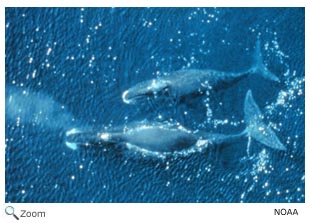 Cetaceans have long, torpedo-shaped bodies; front flippers; hind limbs that are on the inside of their bodies; and tails that end in horizontal flukes. They have an air or blowhole on the top of their head. They have a layer of fat or blubber and a three chambered stomach. Like most mammals, they give birth to live young and feed them milk. Most species in this order are very social and live in groups called pods. There are two suborders in this order - the Mysticeti, or baleen whales and the Odontoceti, or toothed whales. Baleen whales have two blowholes and a plate of baleen that hangs from their upper jaws. Baleen is made of a protein like the one found in human fingernails. The baleen plate is very flexible, and baleen whales use it to strain water through it to capture zooplankton, small fish, and krill and other small crustaceans. Toothed whales have teeth and a single blowhole. There are 70 species in this order in 10 families. Cetaceans have long, torpedo-shaped bodies; front flippers; hind limbs that are on the inside of their bodies; and tails that end in horizontal flukes. They have an air or blowhole on the top of their head. They have a layer of fat or blubber and a three chambered stomach. Like most mammals, they give birth to live young and feed them milk. Most species in this order are very social and live in groups called pods. There are two suborders in this order - the Mysticeti, or baleen whales and the Odontoceti, or toothed whales. Baleen whales have two blowholes and a plate of baleen that hangs from their upper jaws. Baleen is made of a protein like the one found in human fingernails. The baleen plate is very flexible, and baleen whales use it to strain water through it to capture zooplankton, small fish, and krill and other small crustaceans. Toothed whales have teeth and a single blowhole. There are 70 species in this order in 10 families.
|


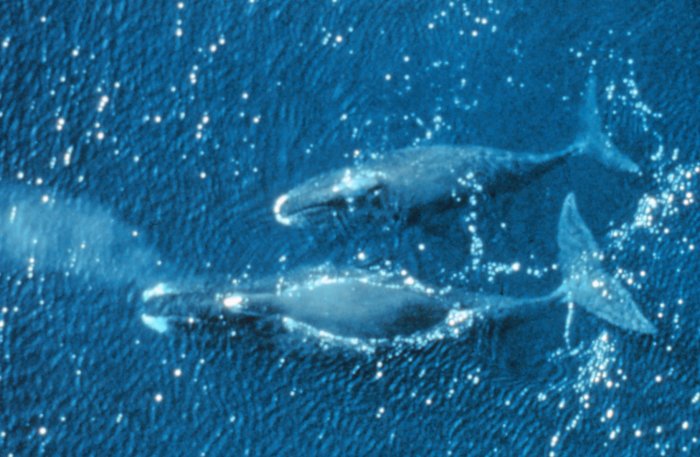 Cetaceans have long, torpedo-shaped bodies; front flippers; hind limbs that are on the inside of their bodies; and tails that end in horizontal flukes. They have an air or blowhole on the top of their head. They have a layer of fat or blubber and a three chambered stomach. Like most mammals, they give birth to live young and feed them milk. Most species in this order are very social and live in groups called pods. There are two suborders in this order - the Mysticeti, or baleen whales and the Odontoceti, or toothed whales. Baleen whales have two blowholes and a plate of baleen that hangs from their upper jaws. Baleen is made of a protein like the one found in human fingernails. The baleen plate is very flexible, and baleen whales use it to strain water through it to capture zooplankton, small fish, and krill and other small crustaceans. Toothed whales have teeth and a single blowhole. There are 70 species in this order in 10 families.