

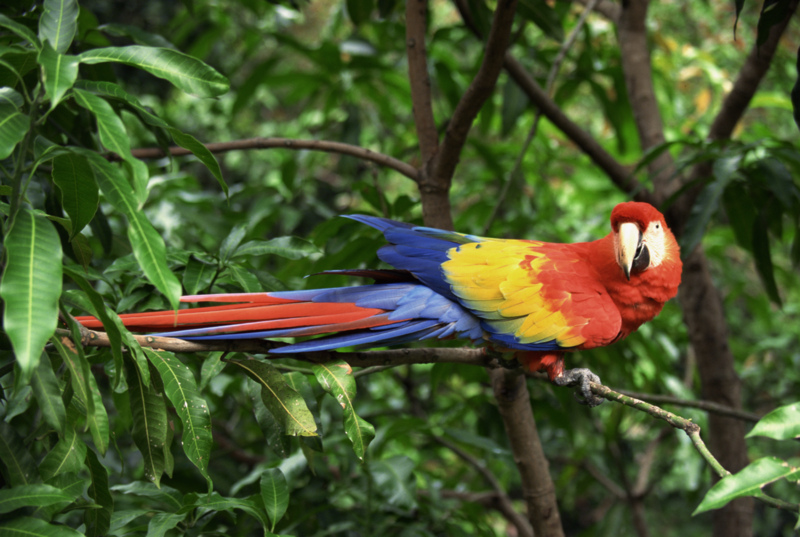
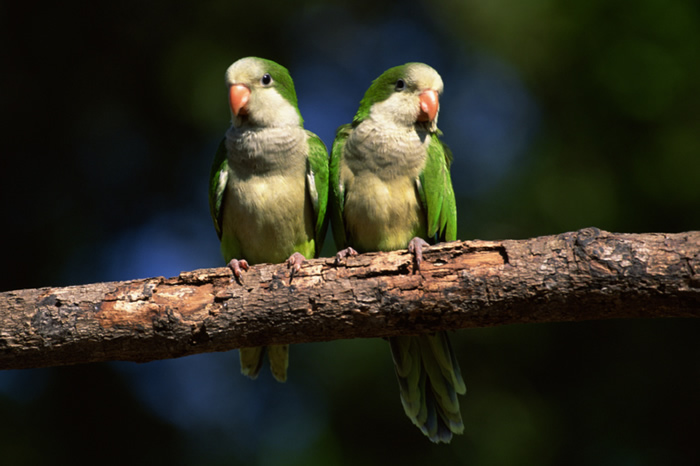
They have thick, hooked bills; zygodactyl feet with two toes pointing forward and two backward; and muscular tongues. The upper mandible of their bill is hinged to their skull and their lower mandible fits under the upper mandible. Their hinged mandible and muscular tongue allow them to easily move food around in their mouths! Most species eat seeds and fruits, but some species also eat insects. They are found in South America, Central America, Asia, Australia, and Africa. Most species live in forests in pairs or small groups. There was once a species found in the southeastern United States, the Carolina parakeet, but it is now extinct. Some species in this order can mimic human speech. The budgerigar is a common pet and has established itself in locations around the country. The budgerigar is the parakeet common in pet stores. It is native to Australia. There are breeding populations of budgerigars in along the Gulf Coast of Florida. The monk or Quaker parakeet is native to
Paraguay, Bolivia, Argentina, and Brazil. Feral breeding colonies can be found in Florida, Connecticut, Delaware, New York, Texas, and
Louisiana among other states.
World Status Key US Status Key
|
|||||||||||||||||||||||||||||
 Least Concern
  Near Threatened
  Vulnerable
  Endangered
  Critically Endangered
  Extinct Wild
  Extinct
 Threatened in NH
  Endangered in US
 Endangered in NH
  Breeds in NH
  Introduced
 Africa
  Antarctica
  Asia
Asia  Australia
  Europe
  North/Central America
  South America
  NH
NH