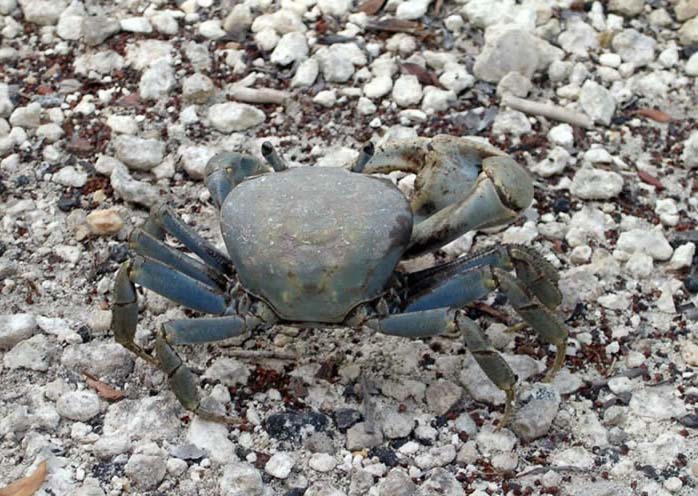

Malacostraca - Crabs, Lobsters, Shrimp, Krill, Pill Bugs |
|
||||
They have exoskeletons and their bodies have three main sections: the head, the thorax, and the abdomen. In most species, the head and the thorax are fused in one section called the cephalothorax. Most of the species in this class have 19-20 jointed body segments. Their head has five segments, their thorax has eight segments, and their abdomen has 6-7 segments. In most species, each segment has a pair of appendages. The species in this class have internal gills and an open circulatory system. In an open circulatory system, blood isn't transported in the body through veins and arteries; it flows freely within body cavities and makes direct contact with the organism's internal tissues and organs! They have green glands in their second antennae that they use to get rid of some body waste. They also have a two-chambered stomach with a special grinding mill that grinds up food. They excrete most of their body waste though an opening on their telson. The telson is the last segment on their body.
|
|||||