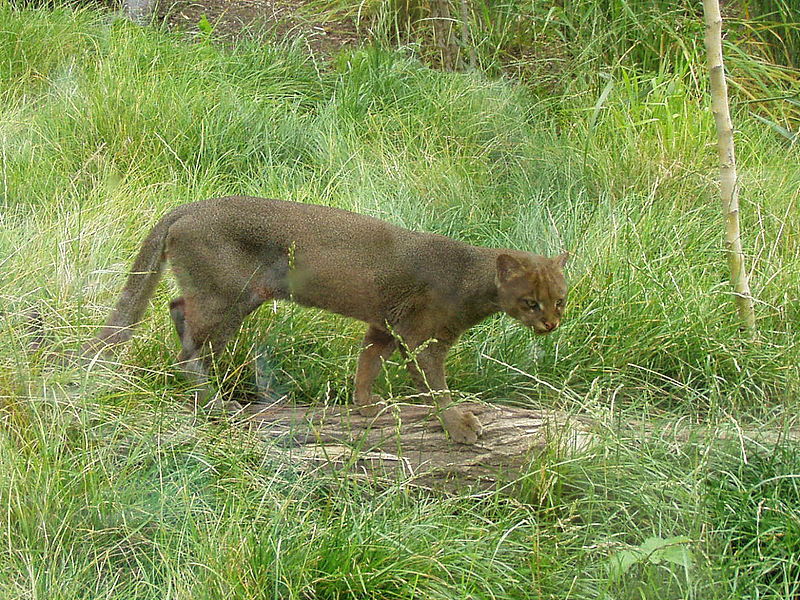

Jaguarundi - Herpailurus yaguaroundi |
|||||||||
Description Range HabitatThe jaguarundi lives in brushy lowland areas with cactus, mesquite, and other spiny plants. It is also found in swamps and forests. It usually lives near water. It does not make its own den; it finds a natural den in a cave, under a bank, or in the tall grass. |
Diet Life CycleThe jaguarundi breeds year-round. After a gestation period of about 75 days, the female gives birth to 1-4 kittens The kittens have spots that eventually disappear. The kittens are weaned when they are about a month old. The mother takes the kittens out and teaches them how to hunt. The kittens stay with their mother until they are about 10 months old. BehaviorThe jaguarundi is a solitary animal and usually only socializes to mate and to raise young. It is a very vocal cat with as many as 13 separate vocalizations. It is mostly active in the day, but is is sometimes active at night. It is a good climber and swimmer. |
||||||||


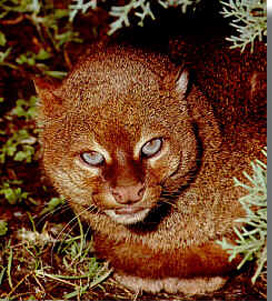
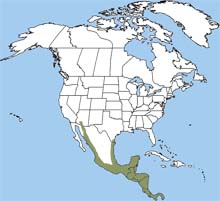 The jaguarundi is native to Central America and the northern and central countries of South America down to Argentina. It can be found, on rare occasions, in extreme southeast Arizona and Texas. The jaguarundi is a federal endangered species in the United States.