Giraffidae - giraffe, okapi
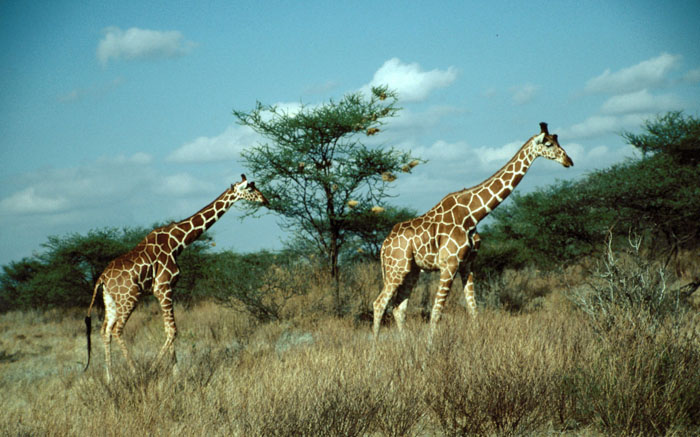
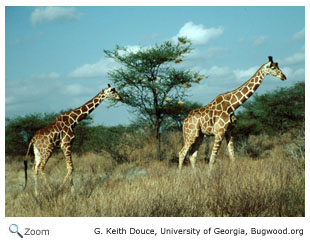 Giraffes and okapis are both found in Sub-Saharan Africa in wooded savannas and open woodlands. The giraffe is the tallest land mammal. Male giraffes can be 16-18 feet tall and weigh up to 2,000 pounds. Females are usually a few feet shorter than the males. Giraffes and okapis are both found in Sub-Saharan Africa in wooded savannas and open woodlands. The giraffe is the tallest land mammal. Male giraffes can be 16-18 feet tall and weigh up to 2,000 pounds. Females are usually a few feet shorter than the males.
The giraffe's front legs are slightly longer than its back legs. The longer front legs help the giraffe support its 6-foot long neck! The giraffe's neck has seven vertebrae, just like other mammals, but its vertebrae are very long! Both male and female giraffes are born with horns.
The giraffe is an herbivore, it browses for leaves and shoots high in the trees and uses its long, black, prehensile tongue to pull leaves into its mouth. The roof of its mouth has grooves on it that help strip the leaves from their branches! Giraffes eat up to 140 pounds of food a day. They are especially fond of the leaves of the acacia tree.
The leaves of the acacia tree contain a lot of water! The extra water helps the giraffe go for long periods of time without drinking water. This helps the giraffe survive! In order to drink water, the giraffe has to spread its legs and bend its long neck down to the water! When it is drinking, it is difficult to spot approaching prey and hard to run away if prey is spotted!
Giraffes live in herds of 10-20 individuals, although some herds can have as many as 100 giraffes. The giraffe is tan with dark brown markings. The giraffe breeds throughout the year. The male mates with more than one female. The female gives birth to a single calf 14-15 months after mating. The calf stays close to its mother for a few weeks and then joins a crèche of other young giraffes. The calf will nurse for up to a year.
There are nine sub-species of giraffe that are identified by the pattern of the dark brown markings and by where they are found in Africa. For example, the Masai giraffe of Kenya has a pattern that looks like oak leaves.
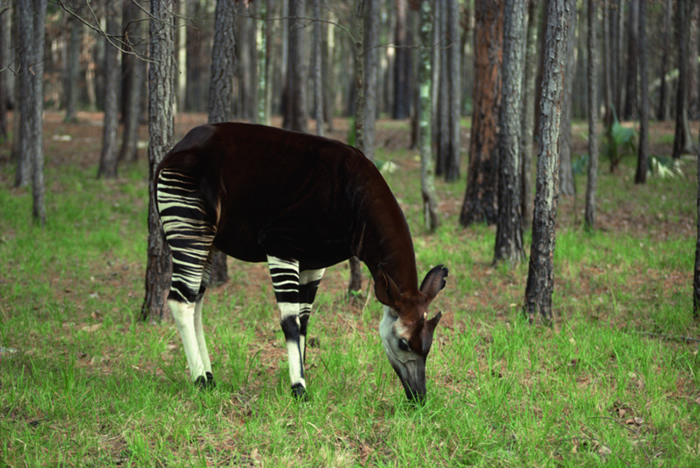
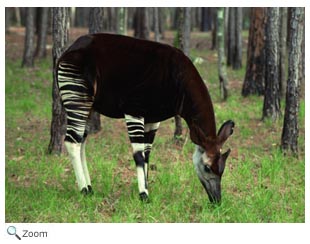 The okapi is found in rainforests in the Democratic Republic of Congo in central Africa. It was not discovered by scientists until 1900. It is 5 to 6.5 feet tall and has black-and-white striped legs and hindquarters, a dark brown body, large ears, and a long tail. The stripes on the okapi's legs help camouflage it in the rainforest. The okapi is found in rainforests in the Democratic Republic of Congo in central Africa. It was not discovered by scientists until 1900. It is 5 to 6.5 feet tall and has black-and-white striped legs and hindquarters, a dark brown body, large ears, and a long tail. The stripes on the okapi's legs help camouflage it in the rainforest.
Like the giraffe, it has a long, black prehensile tongue that it uses to strip leaves and buds off of trees and shrubs. Its front legs are longer than its rear legs, just like the giraffe.
The female okapi gives birth to a single calf. She hides the calf in the underbrush of the rainforest, and for the first two months, she only visits her calf to feed it. By staying away from the calf, except for when she feeds it, the mother protects the calf from being discovered by predators. When the calf is two months old, it joins it mother and browses for food.
World Status Key
 Least Concern Least Concern  Near Threatened Near Threatened  Vulnerable Vulnerable  Endangered Endangered  Critically Endangered Critically Endangered  Extinct in Wild Extinct in Wild  Extinct Extinct
Status taken from ICUN Redlist. If no status is listed, there is not enough data to establish status, or there is no status data for the species.
US Status Key
 Threatened in US Threatened in US  Threatened in NH Threatened in NH  Endangered in US Endangered in US  Endangered in NH Endangered in NH  Introduced Introduced
Status taken from US Fish and Wildlife and NH Fish and Game
New Hampshire Species |
|
North/Central American Species |
| None |
|
None |
Additional Information Resource Key
 Profile Profile  Photos Photos  Video Video  Audio Audio
Giraffe- Giraffa camelopardalis 
There are nine sub-species of giraffe that are identified by the pattern of their dark brown markings and by where they are found in Africa.
Source: Arkive Intended Audience: General Reading Level: Middle School
Giraffe- Giraffa camelopardalis
If humans have seven vertebrae in their necks, how many vertebrae do you think giraffes have? Seven, they are just very large!
Source: San Diego Zoo Intended Audience: General Reading Level: Elementary/Middle School
Giraffe- Giraffa camelopardalis
Male giraffes stand up to 18 feet tall and weigh up to 4,200 pounds; female giraffes grow to 16 feet tall and weigh up to 2,500 pounds. That's tall enough for a giraffe to look into a second story window!
Source: National Zoo Intended Audience: General Reading Level: Elementary/Middle School
Giraffe- Giraffa camelopardalis
The giraffe is the tallest living animal
Source: African Wildlife Federation Intended Audience: General Reading Level: Middle School
Giraffe- Giraffa camelopardalis
Giraffes are native to Africa and are mainly found south of the Sahara to eastern Transvaal, Natal, and northern Botswana.
Source: Animal Diversity Web Intended Audience: General Reading Level: Middle/High School
 Tall Blonde Tall Blonde
Learn more about giraffes at this companion site to the Nature episode about giraffes.
Source: PBS Nature Intended Audience: General Reading Level: Middle/High School
Reticulated Giraffe- Giraffa camelopardalis reticulata
Reticulated giraffe's coats are patterned with large polygons separated by cream-colored lines.
Source: Oakland Zoo Intended Audience: General Reading Level: Middle School
Reticulated Giraffe- Giraffa camelopardalis reticulata
Reticulated giraffes are social animals and live in herds of up to 50 individuals.
Source: Phoenix Zoo Intended Audience: Students Reading Level: Elementary/Middle School
Reticulated Giraffe- Giraffa camelopardalis reticulata
Reticulated giraffes eat shoots, leaves, fruits, and seedpods. They are especially fond of the acacia tree.
Source: The Living Desert Intended Audience: Students Reading Level: Elementary/Middle School
Masai Giraffe- Giraffa camelopardalis tippelskirchi
Masai giraffes live on the African savannahs of Kenya and Tanzania in East Africa.
Source: Los Angeles Zoo Intended Audience: General Reading Level: Elementary/Middle School
Okapi- Okapia johnstoni
The okapi has striped hindquarters and looks like it might be related to the zebra, but it is related to the giraffe!
Source: San Diego Zoo Intended Audience: General Reading Level: Elementary/Middle School
Okapi- Okapia johnstoni
The opaki was first identified by scientists in 1901.
Source: Arkive Intended Audience: General Reading Level: Middle School
Okapi- Okapia johnstoni
The okapi is the only known living relative of the giraffe.
Source: Los Angeles Zoo Intended Audience: General Reading Level: Elementary/Middle School
Okapi- Okapia johnstoni
Okapis are found only in the tropical forests of northeastern Zaire.
Source: Animal Diversity Web Intended Audience: General Reading Level: Middle/High School
Okapi- Okapia johnstoni
The okapi uses its long, sticky tongue to gather leaves.
Source: Enchanted Learning Intended Audience: Students Reading Level: Elementary School |


 Asia
Asia  Australia/Oceania
  Europe
  North/Central America
  South America
  NH Species