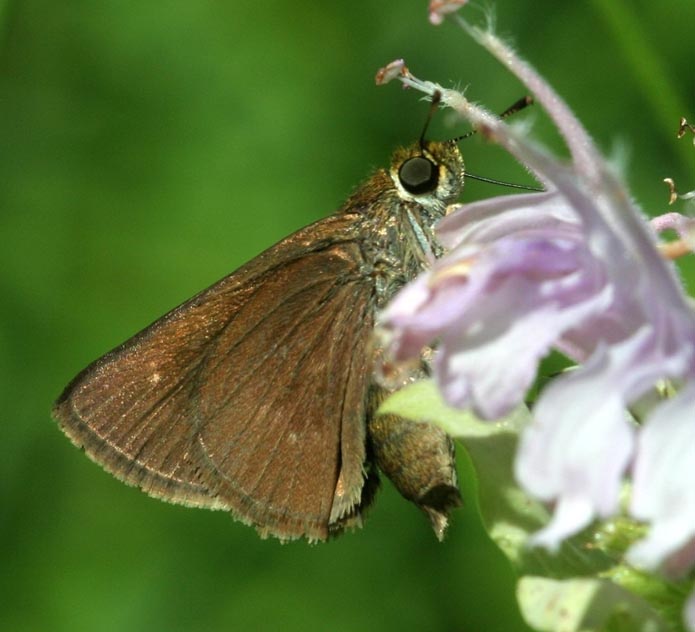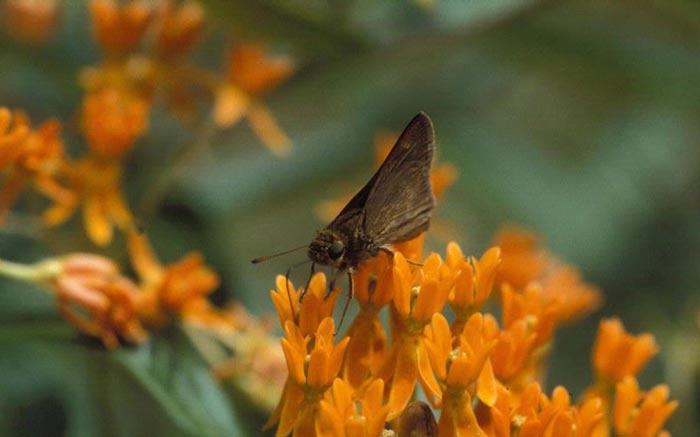

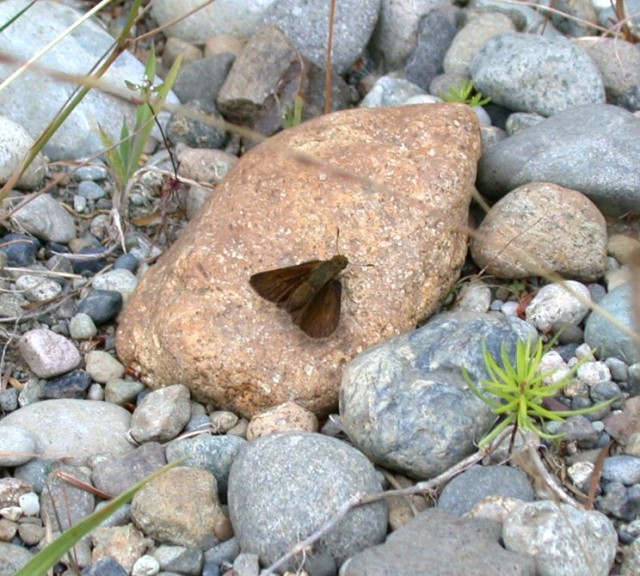
Dun Skipper - Euphyes vestris |
|||||||
Description
The dun skipper has a wingspan of 1 to 1¼ inches. The uppersides of its wings are dark brown. The underside of its wings are tan. The male has a black stigma on his forewings. A stigma is a patch of scent scales found on the forewing of some species of male butterflies. The female may have light white spots on the uppersides and undersides of her forewings. In some groups of dun skippers, the upperside of their head and thorax may be a yellowish-orange. Range |
HabitatThe dun skipper is found in moist areas including woodland edges, roadsides, bogs, gardens, meadows, stream edges, and swamp edges. Diet
Life Cycle |
||||||

 The dun skipper is found
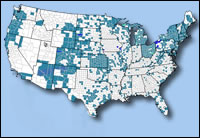
from Maine south to Florida and west to Washington and California. It is also found in southern Canada and northern Mexico.
The dun skipper is found
from Maine south to Florida and west to Washington and California. It is also found in southern Canada and northern Mexico.