Characteristics
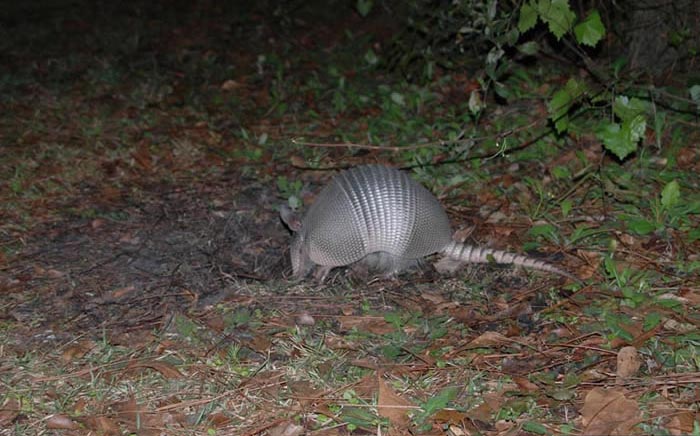
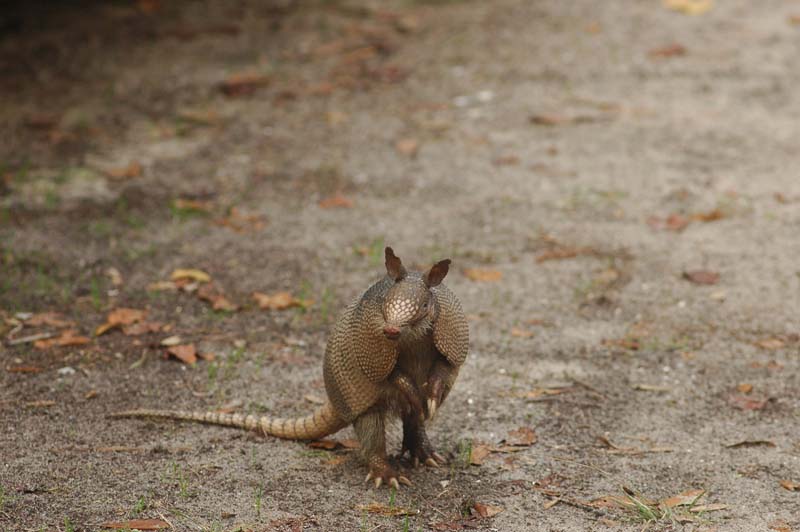
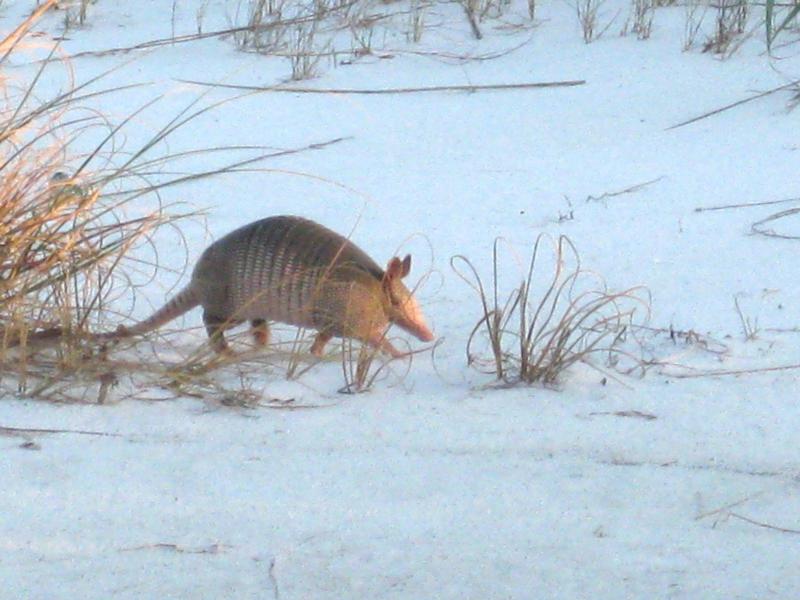
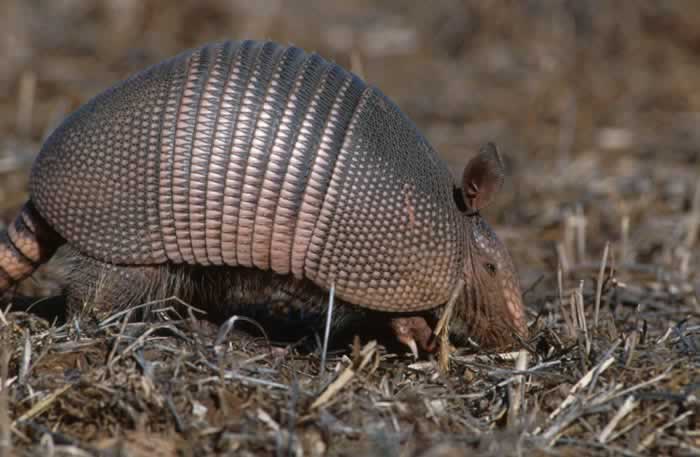
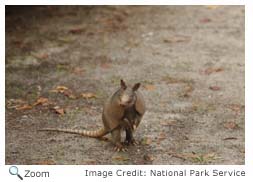 The nine-banded armadillo is the size if a large house cat. It has a gray to brownish-gray body that is 15-17 inches long. Its tail tail is about 14-16 inches long. It has scaly plates called scutes that cover its head, body and tail. The plates on its shoulders and rumps are large. The nine-banded armadillo is the size if a large house cat. It has a gray to brownish-gray body that is 15-17 inches long. Its tail tail is about 14-16 inches long. It has scaly plates called scutes that cover its head, body and tail. The plates on its shoulders and rumps are large.
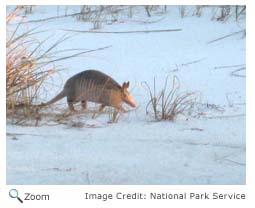 There are nine (sometimes fewer) narrow, jointed armor bands on its midsection that let it bend. It has a small, pointed head with a long snout; peg-like teeth and large, pointed ears. Its front feet have large, thick, sharp claws that help it dig and burrow. Its underparts are soft. Although is is covered in armor, it does have a little fur on its body. There are nine (sometimes fewer) narrow, jointed armor bands on its midsection that let it bend. It has a small, pointed head with a long snout; peg-like teeth and large, pointed ears. Its front feet have large, thick, sharp claws that help it dig and burrow. Its underparts are soft. Although is is covered in armor, it does have a little fur on its body.
With so little fur, the nine-banded armadillo is very sensitive to temperature. In the winter it is usually active during the warmest part of the day. In the summer it is active at night when it is cooler. If temperatures drop too low, the armadillo can die.
Range
The nine-banded armadillo is found in Texas, Oklahoma, Louisiana, and southeast Kansas southeastward to Georgia and most of Florida. In the U.S., the nine-bandd armadillo's range has been expanding to the north, east, and west. It is also found in Mexico, Central America, and South America.
Habitat
The nine-banded armadillo can be found in bottomland hardwood forests, scrub and brushlands. It prefers areas with soft soil that it can burrow into. It is usually found near water sources like streams, creeks and water holes. The armadillo may have more than one burrow.
|
|
|
Diet
The armadillo has a keen sense of smell that it uses to locate prey. Most of its diet is made up of insects, grubs and worms. It will sometimes eat fruit, small reptiles and amphibians and bird eggs.
Life Cycle
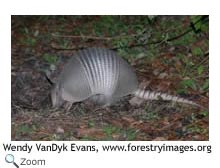 The nine-banded armadillo breeds in the summer. The embryo isn't implanted until 14 weeks after mating. Females almost always give birth to four identical young, all of the same sex, about four months after the embryo is implanted. The young are born with their eyes open and are walking within a few hours. Their skin is soft when they are born, but it slowly hardens as they get older. They nurse for about two months but will stay with their mother for a couple of more months. The nine-banded armadillo breeds in the summer. The embryo isn't implanted until 14 weeks after mating. Females almost always give birth to four identical young, all of the same sex, about four months after the embryo is implanted. The young are born with their eyes open and are walking within a few hours. Their skin is soft when they are born, but it slowly hardens as they get older. They nurse for about two months but will stay with their mother for a couple of more months.
Behavior
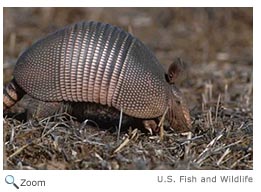 Some people think that the nine-banded armadillo curls itself into a ball when it is frightened. It doesn't! It usually just runs away. Sometimes, when it is startled, it will jump straight up into the air before taking off running. This behavior can cause it to be hit by cars. When a car approaches, the armadillo may leap up and into the oncoming car's bumper. The armadillo can hold its breath for up to six minutes and it sometimes will cross shallow creeks and streams by walking underwater on the bottom to the other side. It also can inflate its intestines to help it swim across the water. Some people think that the nine-banded armadillo curls itself into a ball when it is frightened. It doesn't! It usually just runs away. Sometimes, when it is startled, it will jump straight up into the air before taking off running. This behavior can cause it to be hit by cars. When a car approaches, the armadillo may leap up and into the oncoming car's bumper. The armadillo can hold its breath for up to six minutes and it sometimes will cross shallow creeks and streams by walking underwater on the bottom to the other side. It also can inflate its intestines to help it swim across the water.
|